Product
Industrial chocolate enrobing line – integrated production tailored to your needs
An industrial enrobing line is more than a combination of individual machines. Product and chocolate feeding, processing and automation must work together as one integrated production process.
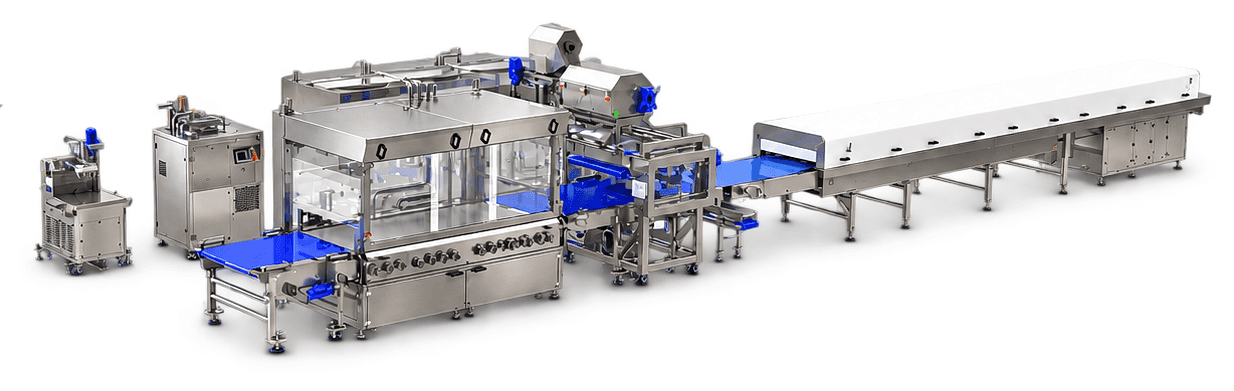
This configuration shows an example of an industrial BETEC enrobing line, built around an E 1200 enrobing machine and designed for high production capacity, efficient product flow and continuous industrial operation.
The line shown is a reference configuration, not a fixed standard layout. For industrial projects, we tailor the final line to your product, required capacity, available space and production process. The level of automation is also determined with a clear purpose. We do not automate for the sake of automation, but seek the solution that best suits your production technically, practically and economically.
What applications does this industrial enrobing line offer?
Depending on the product and the configuration selected, you can, among other things:
- coat the underside of products (bottom coating);
- fully enrobe products;
- partially enrobe products;
- apply decorative chocolate lines using a different type of chocolate;
- decorate products with granulates such as nuts, crisps, sprinkles or other toppings;
- recover and return excess granulate to the decoration process;
- then cool products under controlled conditions for further processing or packaging.
The exact capabilities are always tailored to the product you wish to process. The same underlying approach can therefore be applied to a wide variety of products, such as biscuits, waffles, bars and other chocolate, bakery or snack products.

More information about enrobing lines in general
Key strengths of an industrial BETEC enrobing line
- High production capacity for long and intensive production runs
- Integrated product flow from product feeding to controlled cooling
- Continuous chocolate supply from working tanks to tempering and the enrobing machine
- Controlled tempering and process settings for consistent product quality
- Flexible coating options for different products and finishes
- Integrated decoration options with chocolate and/or granulate
- Recovery of excess granulate via conveying, elevating and sieving systems
- Custom double-walled pipework for controlled chocolate transfer between machines
- Product-specific feeding systems available for controlled and efficient loading of the enrobing machine
- Carefully considered automation based on technical, practical and economic benefits
- Custom design and modular line layout to suit the product, capacity, available space and production process
- Designed for continuous industrial operation
Industrial enrobing lines with production capacity tailored to your product
For industrial enrobing lines, production capacity cannot be expressed as a single fixed kg/h figure. Actual capacity is determined by factors including the type and size of the product, belt loading, belt speed, the required coating and decoration, and the cooling time needed.
We therefore start with your required production capacity, rather than a theoretical maximum. On this basis, the belt width, product feeding, chocolate supply, enrobing machine, cooling and the rest of the line are matched to one another.

An industrial enrobing line tailored to your production process
No two industrial production operations are identical.
This installation is therefore a reference configuration that illustrates the possibilities, scale and investment level of an industrial BETEC enrobing line.
For a specific project, we consider factors including:
- which products you wish to process now and in the future;
- what production capacity you wish to achieve;
- which chocolate, coatings and decorations you use or wish to use;
- how products are fed to the line;
- how chocolate is stored and supplied;
- what level of automation makes sense;
- how much space is available;
- which existing machines need to be retained;
- how often products, recipes or chocolate types are changed;
- and how the line must connect to upstream and downstream production steps.
Based on this information, BETEC can develop a configuration and provide technical proposals, sketches and layouts where necessary. Within this industrial segment, the line is designed around the product, capacity, level of automation, available space and investment budget.
An industrial production line does not necessarily have to be installed in its entirety at once. In some projects, a phased installation of the production line may be worth considering. A basic configuration can be installed first, allowing production to start. As production volumes and requirements increase, the line can be expanded, scaled up and further automated.
This allows the investment to be spread over a longer period and the production line to grow with production. It is important to take future expansions into account during the initial project phase, so that the basic configuration and line layout are technically prepared for them.
Carefully considered automation of industrial enrobing lines – where it adds real value
An industrial production line does not need the highest possible level of automation to achieve maximum production efficiency.
For every project, we therefore assess which operations can usefully be automated and where human intervention remains more practical or economically justified.
Product feeding, positioning, chocolate transfer, tempering, enrobing, decoration, recovery, cooling and subsequent product discharge can all be integrated to varying degrees.
In doing so, we consider factors including production volume, product changeovers, cleaning, available operators, available space and future expansions.
The aim is a high but carefully considered level of automation, with technology and investment remaining proportionate to the expected return and the real added value for your production.
Which machines are included in this industrial enrobing line?
The configuration below is one specific example of how an industrial BETEC enrobing line can be built. The final machines and line layout are always tailored to your specific production process.
The links in the list below provide further information about the machines concerned or a comparable version from the same product range.
This reference configuration comprises:
- Product infeed / infeed conveyor → TB..PU controlled feeding to the enrobing machine
- Industrial enrobing machine → E 1200
- Continuous automatic tempering machine → CAT 200 for the main chocolate flow
- Working tank and chocolate buffer → MKT triple tank
- Double-jacketed pipework → controlled chocolate transfer between tanks and machines
- Separate tempering machine for decoration → MT 80 GPE
- Integrated or separate chocolate decoration → CSDL string decorating machine for applying decorative chocolate lines, integrated into the enrobing machine or positioned separately above the production line
- Granulate decoration → MGD for applying different granulates
- Sieving and return system → recovery of excess granulate
- Controlled product cooling → BETEC cooling tunnel
Expansion options for your industrial enrobing line
The line shown is one example of what is possible within an industrial BETEC installation.
Depending on your application, additional machines and process steps can be integrated. Examples include adapted product feeding, other decoration systems, additional chocolate flows, conveying systems to subsequent production steps or additional process control.
Chocolate handling before tempering can also be integrated further. For example, an ISU inline sieving system with a buffer tank can be installed between the external chocolate supply and the tempering machine. It continuously filters the liquid chocolate before tempering while providing a stable chocolate supply from the buffer tank.
Larger installations can also incorporate extensive chocolate transfer systems and ring mains to supply one or more points of use from a central chocolate supply.
The final installation is therefore determined not by how many machines we can add, but by which processes your production actually needs.
How does this industrial enrobing line work?
Chocolate flow – from central storage to the enrobing machine
Larger chocolate production operations and factories often use central chocolate storage. Depending on the production environment, storage tanks can have capacities ranging from approximately 10,000 to more than 40,000 kg.
From this central storage, the chocolate required can be pumped to the production line’s working tank or working tanks.
MKT triple chocolate tank as a working tank and buffer
In this reference configuration, an MKT triple tank is used as the working tank.
The MKT serves as a working tank and chocolate buffer for further processing and can be supplied from central chocolate storage. From this working tank, the chocolate is fed to the CAT 200.
With three separate tanks available in a single installation, different chocolate flows can be managed independently. The MKT can, for example, be used for dark, milk and white chocolate. The three vessels can contain the same or different types of chocolate. Depending on the required operating method, they are connected to a shared tempering machine or separate tempering circuits. The choice of working tank or tank configuration depends on the specific production requirements.
BETEC MK, MKD and MKT melting tanks are designed for melting and buffering chocolate and can be connected to subsequent machines in the production line via pumps and pipework.
CAT 200 – continuous automatic chocolate tempering machine
From the working tank, the chocolate is pumped to the CAT 200 continuous automatic tempering machine.
Here, the chocolate is tempered before being fed on to the E 1200. The CAT 200 can automatically supply other machines, forming the link between the chocolate supply and the enrobing process itself.
Depending on the required capacity and chocolate flows, a CAT 200D with two separate tempering circuits can also be used. This allows different chocolate flows to be tempered independently. It offers additional flexibility when processing different types of chocolate and can simplify production changeovers.
However, not every application requires a tempering machine. For coatings such as compound, which do not require tempering, this process step can be omitted depending on the application.
For very large chocolate volumes, an external industrial tempering system with a higher capacity can also be selected. BETEC can integrate such systems into the overall line when this is a better technical and economic fit for the required chocolate capacity. The choice of tempering solution is therefore determined by the product, the chocolate flows needed and the required production capacity.
After enrobing, unused chocolate can be pumped back to the working tank, depending on the configuration selected.
Double-jacketed pipework – controlled chocolate transfer throughout the installation
In industrial production lines, transferring chocolate between the various machines also becomes an important part of the process.
BETEC can provide custom double-walled stainless steel pipework with a water jacket for this purpose. This connects the various tanks, tempering machines and points of use, while allowing the chocolate to be maintained at the required temperature during transfer.
The pipework can be used to transfer chocolate between individual machines, but in larger installations it can also be configured as a ring main for tempered chocolate. From a central tempering machine, the chocolate is circulated past one or more points of use.
Chocolate that is not used within the circulation system can be passed through a decrystalliser at the end of the ring main. Here, the crystals formed during tempering are melted again, after which the chocolate flows back to the working tank. From this working tank, the chocolate can be drawn in again by the tempering machine’s pump, tempered and returned to the ring main.
This creates a closed chocolate circuit that can supply multiple points of use under controlled conditions, without repeatedly having to move chocolate manually between machines.
Product flow – controlled handling from infeed to cooling
In parallel with the chocolate flow, the products are conveyed through the installation.
How this is achieved depends greatly on the product. A simple infeed conveyor may be sufficient, but for high volumes and products with consistent dimensions, an automatic feeding or sorting system can load the enrobing line much more efficiently.
Automatic product feeding for optimal loading of the enrobing machine
An industrial enrobing machine can only make full use of its capacity when product feeding is matched to it and the enrobing machine’s coating belt is optimally loaded.
Feeding systems can therefore be integrated or developed specifically for an application. One concrete example is the RCI-inliner, which BETEC developed for rice cakes.
This machine arranges and positions the products and removes broken or misshapen products before they reach the enrobing machine’s infeed conveyor. Products can also be fed with controlled spacing, so that they do not touch during enrobing and the available belt width is used efficiently.
The same principle can be adapted to other uniform products such as biscuits, waffles, muesli bars or protein bars.
The feeding system is therefore tailored to the product, the required capacity and the way in which the preceding production step delivers the products.
E 1200 industrial enrobing machine – the heart of the enrobing process
Once correctly fed, the products reach the 1200 mm wide wire mesh belt of the E 1200 industrial enrobing machine.
Depending on the version, products can be bottom-coated, fully enrobed or partially coated.
Within an integrated production line, the E 1200 can also act as the central control point for the entire enrobing process. One or more touchscreens give the operator a clear, user-friendly overview of both the machine and the connected parts of the production line.
In addition to the enrobing machine’s process parameters, infeed and outfeed conveyors, belt speeds, chocolate supply, decorating machines, the cooling tunnel and other integrated functions can also be monitored and controlled from this central interface, depending on the line layout. This removes the need for the operator to control each machine separately and keeps the entire process clearly visible from one central position.
The machine’s PLC includes a recipe library. This allows settings for recurring products to be stored and reused later, contributing to a reproducible process during long and repeated production runs.
For cleaning, maintenance and product changeovers, the E series can be equipped with features including a roll-out wire mesh belt and roll-out chocolate container.
Decorative chocolate lines – integrated or as a separate module
A string decorator can be integrated into the E 1200 line in various ways to apply decorative chocolate lines.
The decorating machine can be built directly into the E 1200, above the wire mesh belt. A separate collection tray inside the machine catches excess decorating chocolate. This allows products to be enrobed and decorated with chocolate lines in one continuous process, without the need for an additional conveyor module.
A second option is an external string decorator downstream of the E 1200. After enrobing, the products are transferred to a separate mesh belt or conveyor belt, above which the string decorator is positioned. This version offers additional flexibility: the decoration module can be removed from the line when it is not needed, and several decoration steps can be arranged in succession.
For example, a product can first be enrobed and decorated with a first colour of chocolate, followed by a second decoration in a different chocolate colour on the external decorating conveyor. This enables more complex, multicoloured decoration patterns to be produced in one continuous production line. Consider, for example, the characteristic yellow and green line pattern on Dubai chocolate bars: a similar visual effect can also be applied to enrobed products using two consecutive string decorators.
A separate tempering machine can be provided for each chocolate colour, allowing the different chocolate flows to be processed independently. In the reference configuration shown, an MT 80 GPE supplies the string decorating machine with tempered chocolate.

Granulate decoration with integrated recovery
When granulate decoration is part of the line, products are conveyed to the cooling tunnel after enrobing via an intermediate conveyor. A Multi Granulate Decorator can be positioned above this conveyor belt.
The intermediate conveyor also plays an important role in granulate recovery. The transfer point between the intermediate conveyor and the cooling tunnel creates a controlled collection point for excess granulate. Granulate that lands beside or between the products can fall through and be collected here before the products enter the cooling tunnel. This prevents excess granulate from entering the cooling tunnel and causing unnecessary soiling.
The Multi Granulate Decorator allows granulates such as nuts, crisps, sprinkles or other toppings to be distributed over the products in a controlled manner.
Depending on the configuration selected, the recovered granulate is collected in a tray or conveyed onwards for automatic recovery. In this reference configuration, excess granulate falls onto a transverse conveyor at the transfer point. This carries the material to an elevating conveyor, which transports it back upwards.
The recovered granulate is then sieved and fed back to the granulate decorating machine.
This combines decoration, recovery, conveying, sieving and refeeding within one continuous process.

Controlled cooling as the final process step
After enrobing and decoration, the products go directly to the BETEC cooling tunnel.
When processing real chocolate, controlled cooling is important to allow crystallisation to continue and obtain a stable end product.
The cooling time required, and therefore the length and design of the cooling tunnel, are matched to factors including the product, belt speed and required production capacity. For real chocolate, the usual basis is an average cooling time of approximately 8 to 12 minutes, with the exact tunnel dimensions adapted to the application.
After the cooling tunnel, products can be removed or conveyed directly to a subsequent production step, such as a packaging line.
When should you choose an industrial BETEC solution?
An industrial BETEC solution is intended for production environments where capacity, continuity, process control and integration are central. This level is particularly appropriate when you:
- carry out long production runs lasting several days and need the production line to operate continuously for extended periods;
- want to achieve high production capacities within an integrated production process;
- want to maintain high and reproducible product quality, even during extended production runs;
- want to achieve a high level of automation, based on what genuinely adds value technically, practically and economically;
- want to closely integrate product and chocolate flows, so that different machines and process steps work together in a controlled manner;
- want to reduce manual intermediate steps and product handling by purposefully connecting feeding, conveying, processing and discharge;
- need a custom production line, tailored to your product, capacity, available space and existing production environment;
- want to allow for future expansion, for example with additional process steps, product flows or further automation.
Discuss your industrial project with BETEC
Don’t just tell us which machine you are looking for. Tell us what you want to produce.
Send us information about your product and production requirements. Together, we will develop an industrial line configuration that suits your capacity, process and future needs.
→ Discuss your production plans with BETEC
Photos